
The IEA's coordinated release of 400 million barrels from strategic reserves has been described as the largest emergency stockpile drawdown in the agency's 52-year history. The number has dominated headlines and been deployed by policymakers as evidence that the world is responding seriously to the supply shock caused by Iran's effective closure of the Strait of Hormuz. It is a large number. It is also, in practical refining terms, a substantially misleading one.
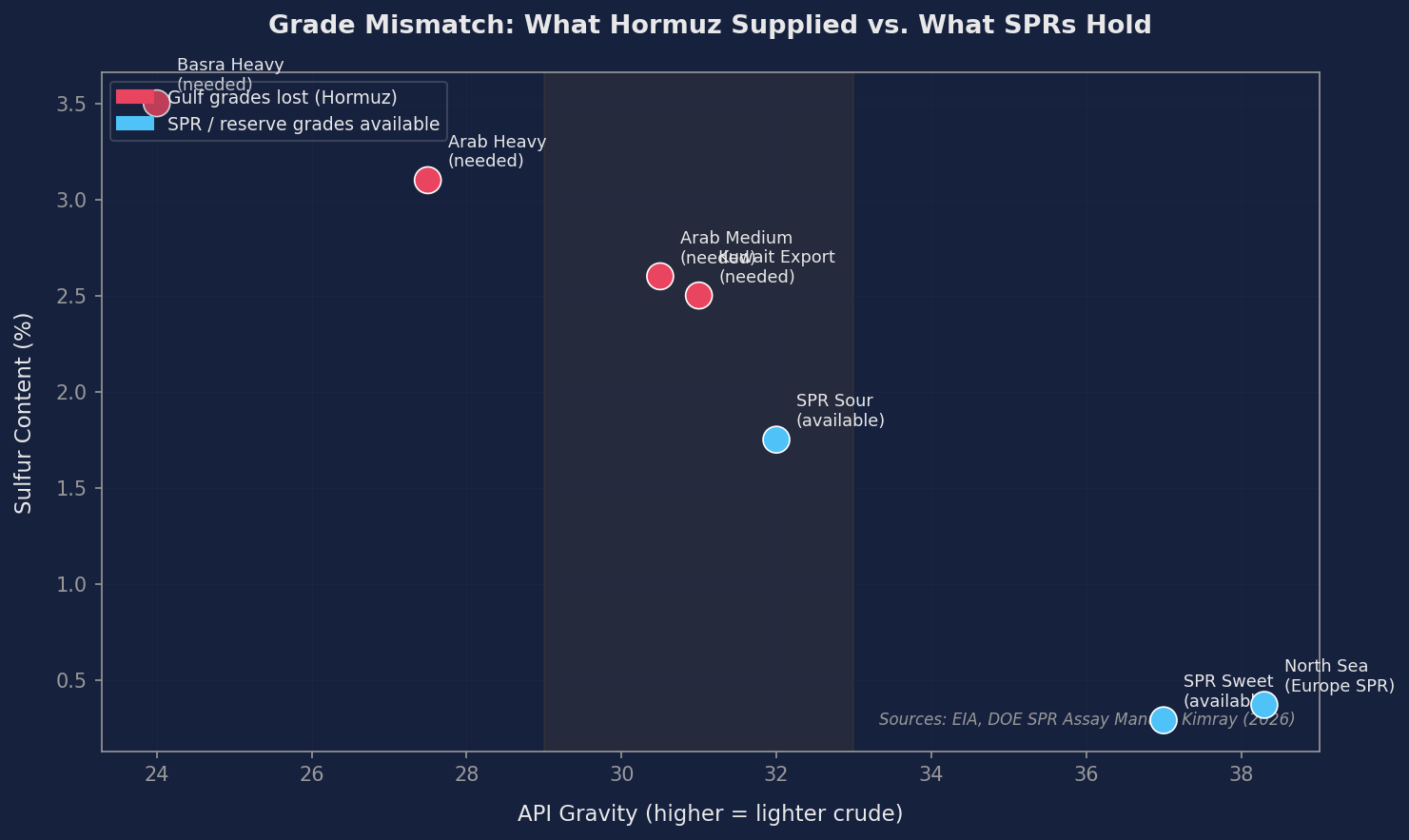
Start with what is actually missing. Before the closure, the Strait of Hormuz was moving approximately 20 million barrels per day of crude oil and petroleum products — around 20 percent of global petroleum liquids consumption. Almost 90 percent of those volumes were destined for Asian markets. The grades transiting that waterway were overwhelmingly medium-to-heavy sour crudes: Arab Medium from Saudi Arabia (API gravity 29–32°, sulfur 2.2–2.9%); Arab Heavy (below 29° API, above 2.9% sulfur); Basra Heavy from Iraq (roughly 24° API, sulfur around 3.5%); and Kuwait Export Crude (approximately 31° API, 2.5% sulfur). These are dense, high-sulfur barrels — precisely what the refining infrastructure of Asia was built to process.
South Korean, Japanese, Chinese, and Indian refiners have spent decades configuring their plants around Gulf heavy sour crude. The economic logic is straightforward: heavy sour crude trades at a discount to light sweet because it is harder to process. Refineries willing to invest in vacuum distillation units, cokers, hydrocrackers, and high-capacity hydrotreaters could buy discounted feedstock and upgrade it into premium products. The complex refining infrastructure of Asia was built specifically to run the grades now stranded behind the Hormuz blockade.
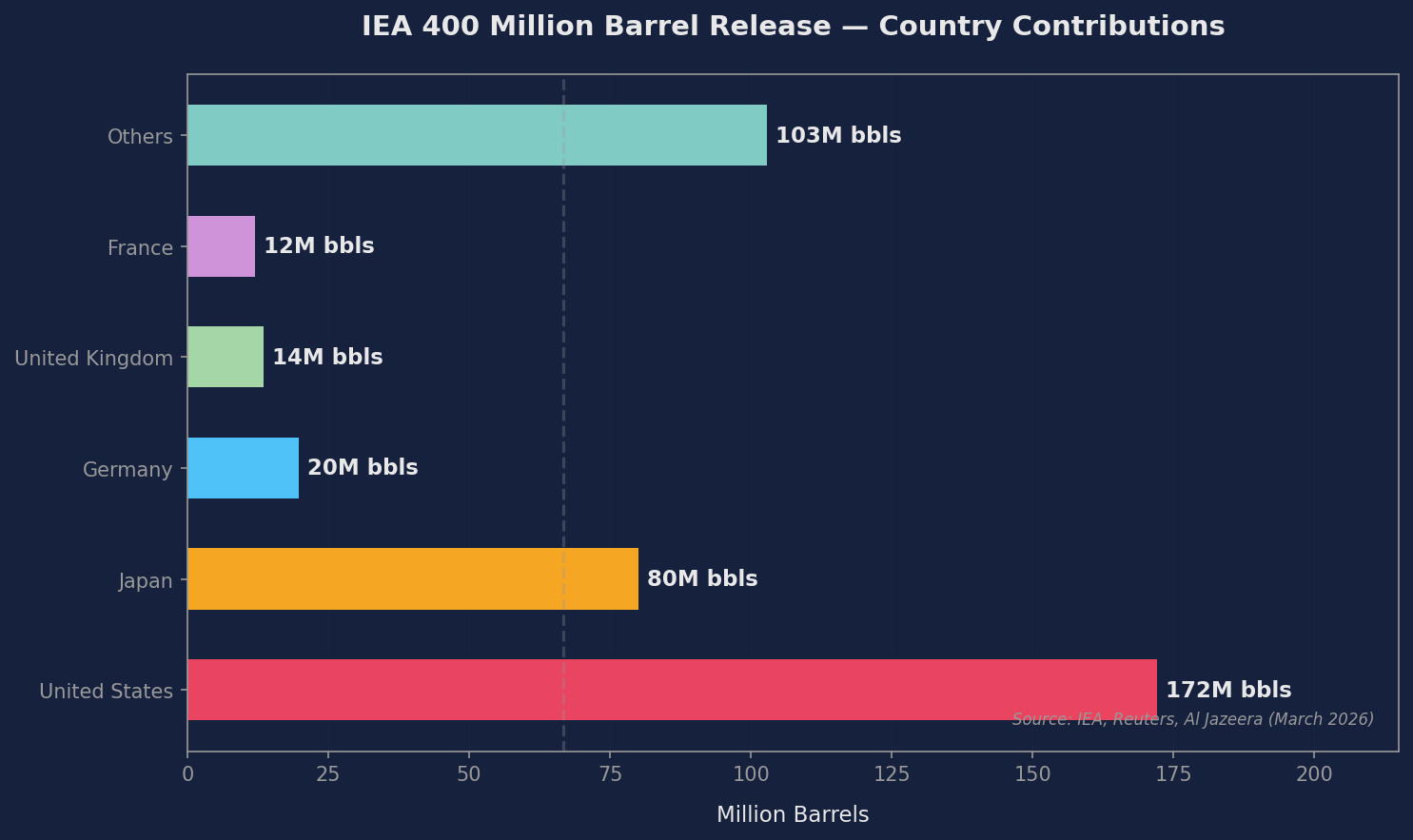
Now consider what the SPR is actually releasing. The US Strategic Petroleum Reserve holds exclusively crude oil — no refined products — stored in underground salt caverns along the Gulf Coast. According to the official DOE SPR crude oil analysis, the reserve's crude sits at 30 to 40° API gravity and under 2.0 percent sulfur, segregated into sweet (max 0.50% sulfur) and sour (max 1.99% sulfur) streams. The US contribution to the IEA release is 172 million barrels over approximately 120 days — implying roughly 1.4 million barrels per day, or about 15 percent of the lost Hormuz flow.
The critical technical distinction that has gone almost entirely unexamined in public commentary is that sour and heavy are not the same property. They are measured on completely independent axes. API gravity measures density; sulfur content measures processing complexity. What disappeared from the Strait of Hormuz was predominantly heavy sour crude. What the SPR holds is lighter, lower-sulfur crude — the official DOE assay data confirms the SPR sour stream peaks at 1.99 percent sulfur, well below the 2.9–3.5 percent sulfur of the Arab Heavy and Basra Heavy grades it is being asked to replace. It is not a functional analogue for those grades.
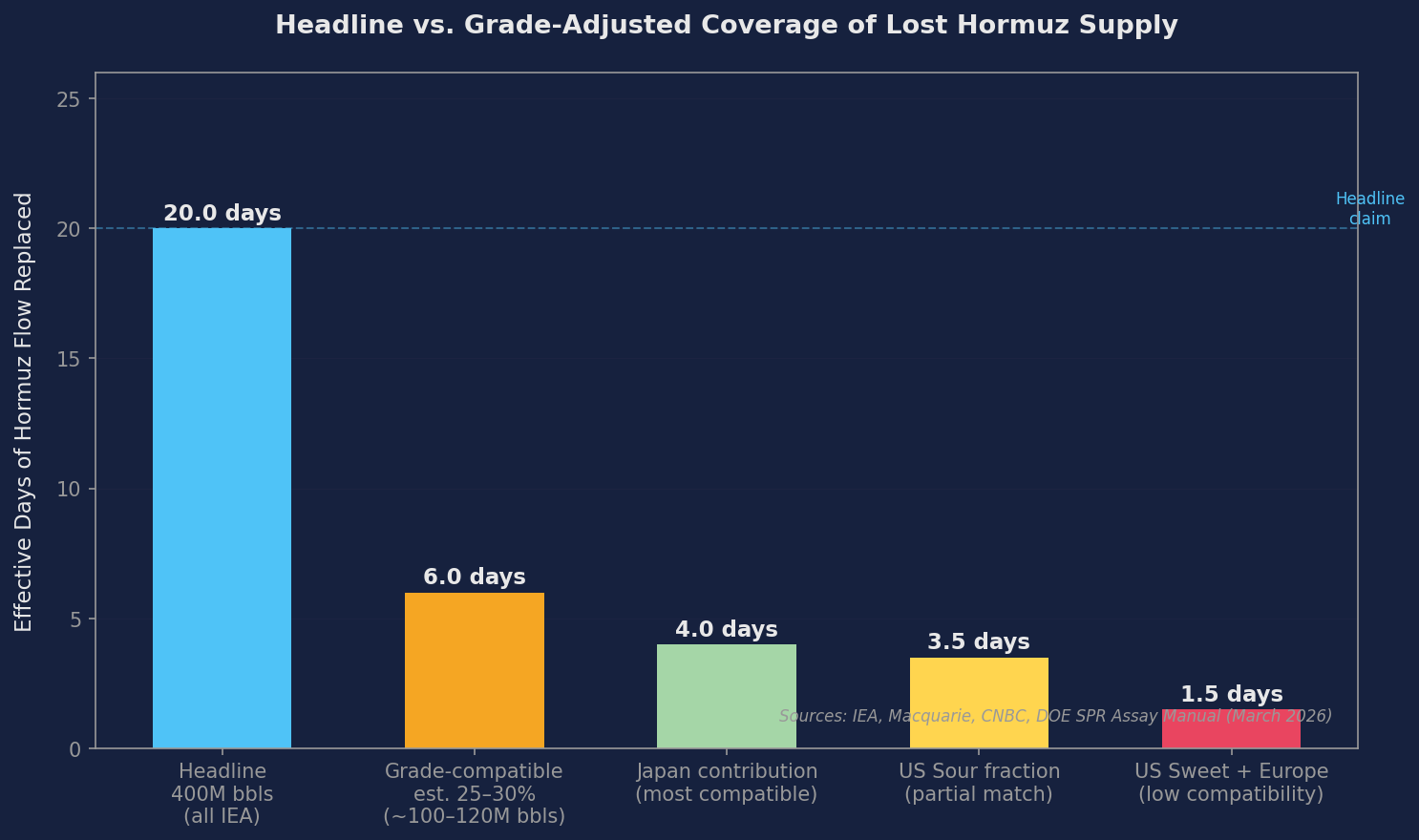
This matters enormously at the refinery level. When a complex Asian refinery configured for Arab Heavy receives lighter SPR crude instead, three things happen simultaneously. First, the yield slate shifts in the wrong direction: Arab Heavy and Basra Heavy produce substantial quantities of vacuum gasoil and atmospheric residue, which feed the coker and hydrocracker to generate diesel and jet fuel. Lighter replacement crudes produce a naphtha-heavy yield, at a moment when Asian markets are short on middle distillates, not naphtha. Second, the hydrotreater — calibrated for high-sulfur feedstock — runs under-loaded, reducing operational efficiency. Third, the coker runs below its design throughput. These units represent billions of dollars in capital expenditure. Feeding them the wrong crude does not break them, but it substantially erodes the economics of the entire configuration.
The practical implication for the 400 million barrel figure is significant. The US sweet fraction is largely incompatible with the Asian complex refineries most acutely affected by the Hormuz closure. The US sour fraction is a partial match for refineries running Arab Medium, but not for those configured around Arab Heavy or Basra Heavy. Europe's contributions are primarily petroleum products and lighter North Sea-grade crudes, compounding the grade mismatch for Asian buyers.
Japan's contribution is the most grade-compatible of the entire coordinated release. Japan sources approximately 95 percent of its crude from the Middle East — primarily Saudi Arabia, Kuwait, the UAE, and Qatar — and stores Gulf crude in its strategic reserves for exactly that reason. Japan has committed around 80 million barrels to the IEA release. That fraction will reach refineries that can actually run it as intended. It is, however, a minority of the total 400 million barrels.
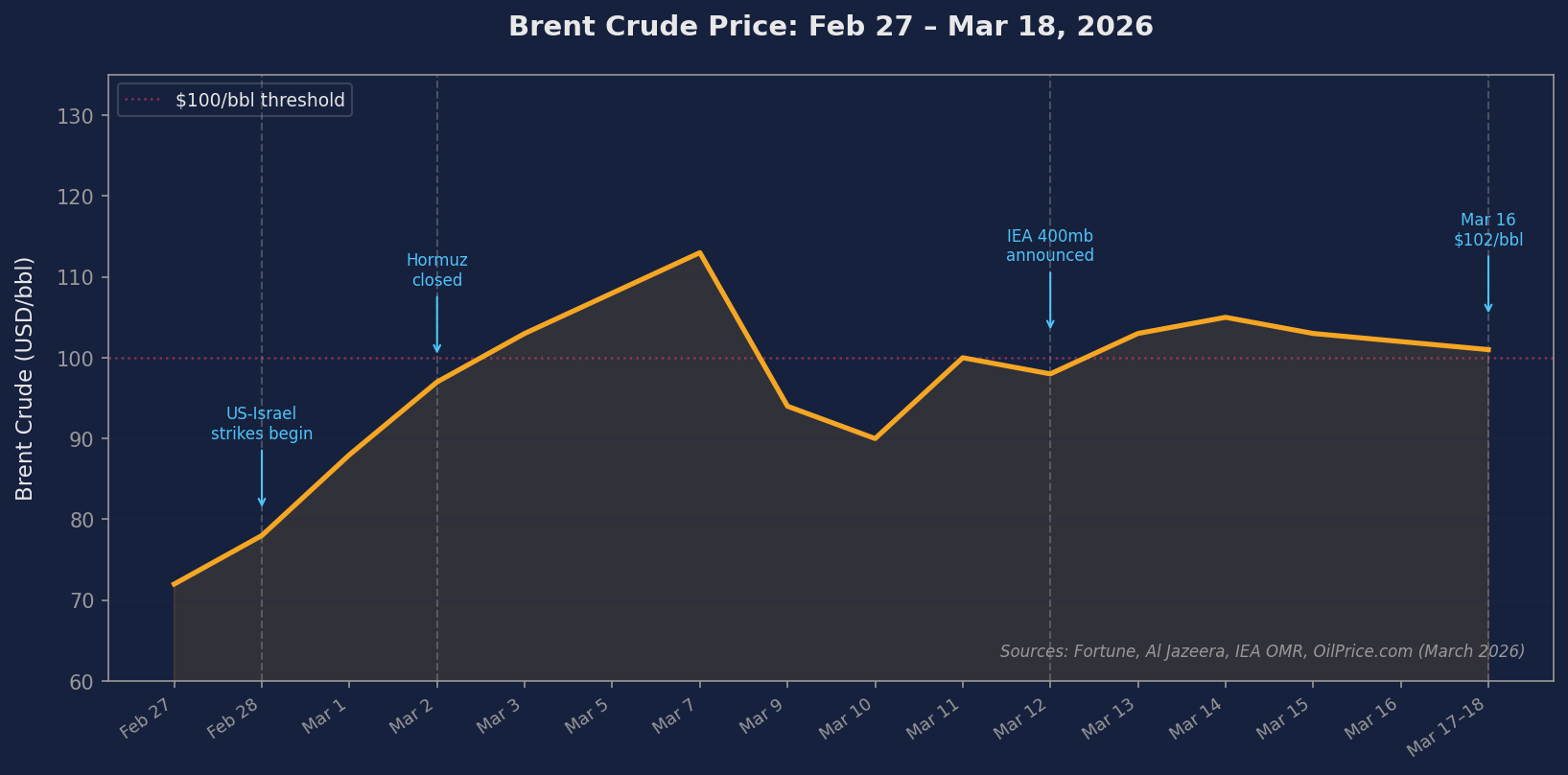
None of this diminishes the significance of the policy action. The coordinated release is the correct response to a supply shock of this scale, and its signalling effect has its own stabilising function in futures markets. But markets that have continued to trade above $100 per barrel despite the announcement are not being irrational. They are doing the same grade arithmetic. The question was never whether 400 million barrels existed somewhere in government storage. The question is how many of those barrels can actually run in the refineries that are running short — and the answer, as of March 18, 2026, is considerably fewer than the headline suggests.