






Articles
- BLOG / Articles / View
- Articles
Monday Macro View: Frac Chemistry Reveals Different Operator Strategies
By Osama on October 26, 2026 in Market Sentiment
Last week, we used our Frac Chemistry Inspector to look at five operators: Chevron, Diamondback, Occidental, Devon and ConocoPhillips. Between January and September 2026, these companies completed 546 frac jobs under their own names. We chose them because they are active, they have meaningful exposure to the Permian, and they don't all operate the same way. What we wanted to understand was fairly straightforward. Where are they working, what kind of jobs are they running, and who is supplying the chemistry?
We picked these five for three reasons: their scale in the Permian, the volume of frac jobs they've completed this year, and the different ways they operate across basins. That gives us a meaningful comparison rather than looking at five companies doing essentially the same thing.
Let's start with where the work is happening. Chevron and Diamondback have something in common. Both are heavily concentrated in Midland County, Texas. For Chevron, 41% of its recorded jobs were in Midland County. For Diamondback, the figure was 42%. Between them, they accounted for almost all of the more than 100 jobs recorded in that county across our five operators. Now compare that with Occidental and Devon. Occidental's busiest county was Glasscock, Texas, but it accounted for only 22% of its jobs. Devon's busiest was Lea County, New Mexico, also at 22%. Their activity is spread across more counties and, in Devon's case, several basins. ConocoPhillips is different again. Its busiest county was Live Oak, Texas, where it completed 37% of its jobs. That's Eagle Ford activity, not Permian. Its Permian wells are filed under COG Operating, the former Concho, so they don't appear under the ConocoPhillips name in this comparison.
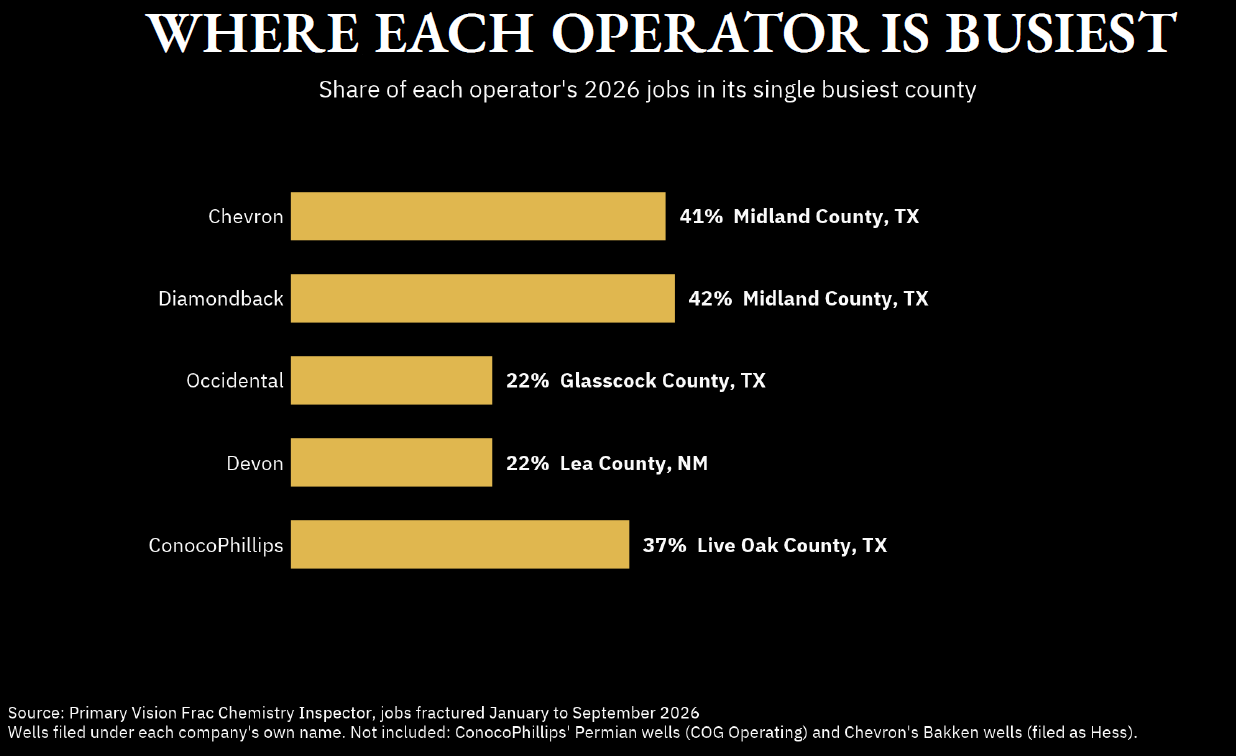
Why does this matter? Because if you're selling chemicals, pumping services or equipment, knowing an operator's total activity isn't enough. You need to know where that activity is concentrated. A company with 100 jobs spread across several basins presents a different opportunity from one completing almost half its work in a single county. Now look at the size of the jobs. This is where the five operators start looking remarkably similar. Chevron classified 96% of its jobs as large. Devon was at 94%, Diamondback at 92%, ConocoPhillips at 89%, and Occidental at 88%. In other words, regardless of where these companies operate, large jobs account for the overwhelming majority of their completions.
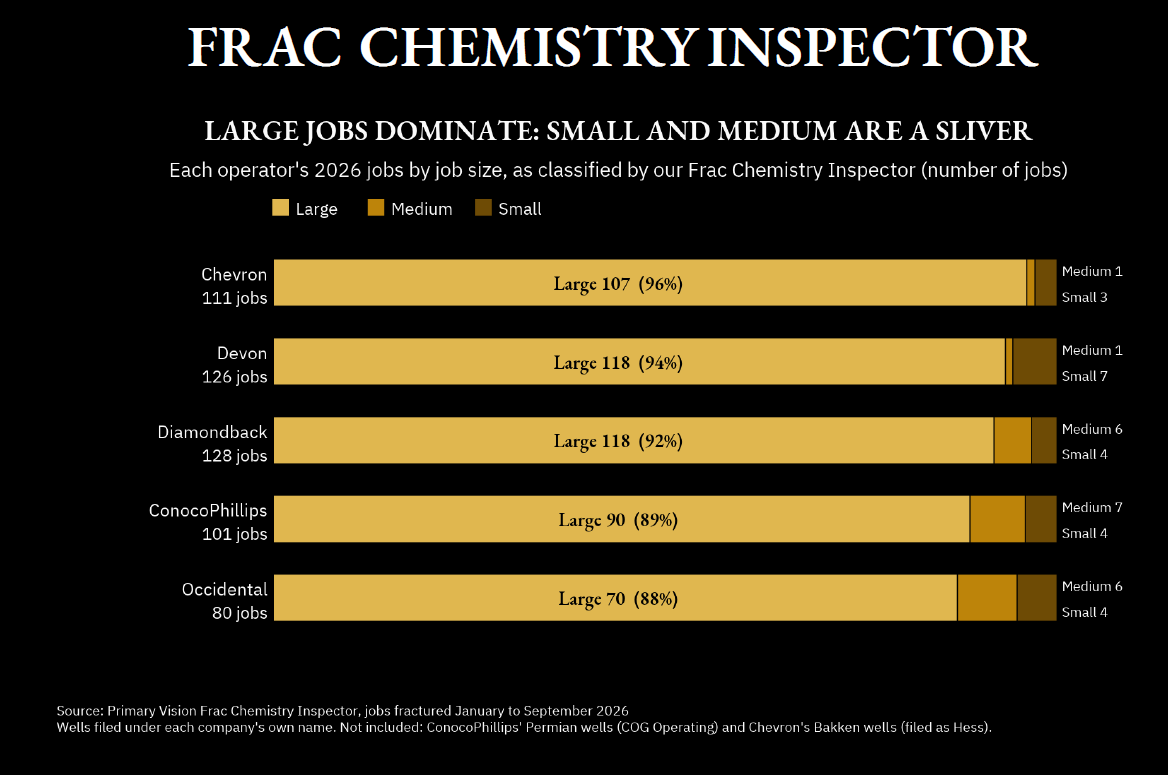
There's a reason for that. Operators have been moving toward multi-well pads and simultaneous fracturing because they can get more work done in less time. The EIA found that the average number of horizontal wells completed simultaneously increased from 1.5 in 2014 to just over three in 2024. Chevron has said that fracturing three wells at once can reduce the time needed to bring wells online by roughly 25% and cut per-well costs by about 12%. For the companies supplying these operations, larger jobs mean more water, more sand, more chemistry and tighter coordination. But here's where the story gets interesting. Even though these operators are running similar-sized jobs, they aren't buying their chemistry the same way.
Look at Diamondback. Halliburton is its main chemistry supplier on 80% of the wells in our supplier comparison. Chevron also relies heavily on Halliburton, at 70%, with Select Chemistry supplying the remaining 30%. ConocoPhillips uses ProFrac on 80% and Halliburton on 20%. Now look at Devon. Innospec, a specialist chemical company, supplies 100% of the wells in the comparison. Occidental uses Solnexus on 71%, with Halliburton accounting for the other 29%.
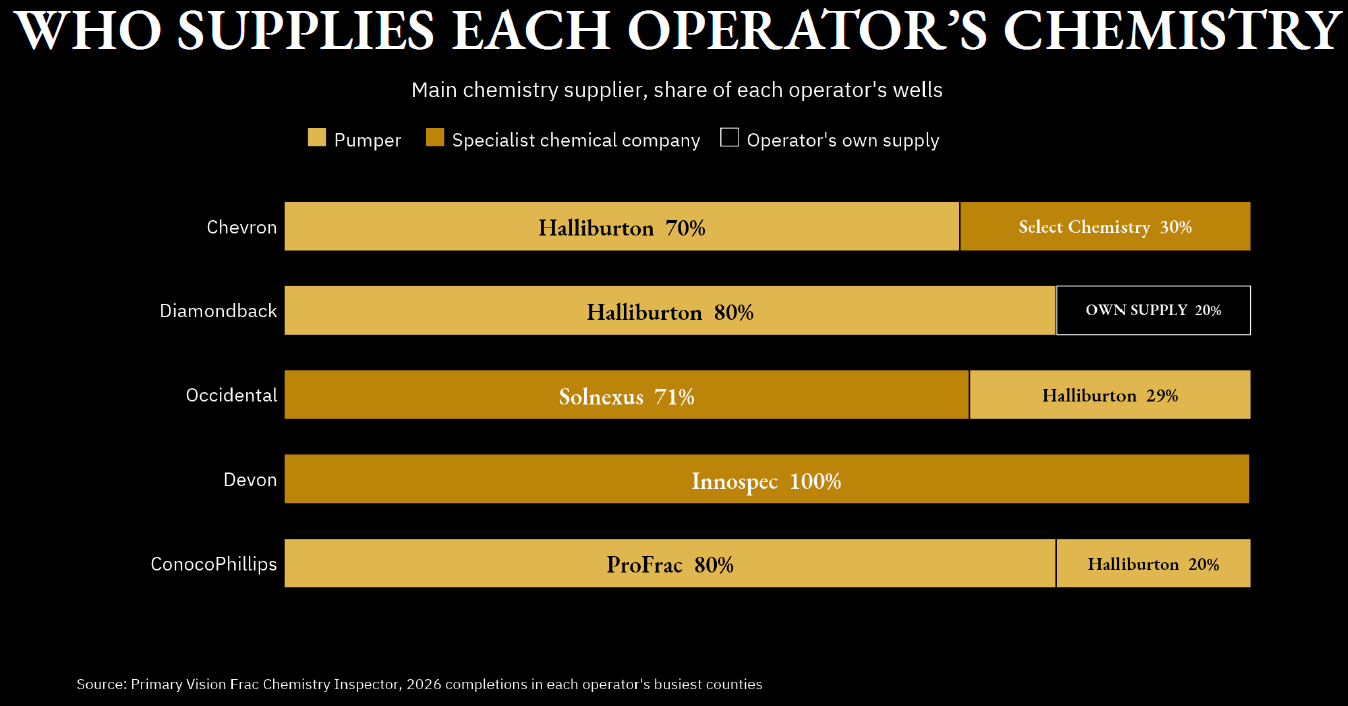
Think about what that means if you're trying to win chemistry business. With one operator, the relationship you need may be with the pressure pumper. With another, you may need to approach the operator directly. And those differences can exist between companies operating in the same basin, running essentially the same type of completion. That's what we wanted to show with these three charts. Knowing how many wells an operator completes tells you something. Knowing where those wells are, how large the jobs are, and who supplies the chemistry tells you considerably more.
And that is precisely why we built the Frac Chemistry Inspector. You can take the same approach with other operators, other counties and other basins. The five companies we've looked at here are just a starting point.
Tags:
Permission denied
Upgrade to Pro Today and get…
• This article — plus dozens more each month, all within our full Research Module
• Frac Hits — our National-Level Frac Spread Count and Frac Job Count, updated weekly
• Frac Operator Monitor — detailed FSC & FJC by operator
• And so much more, designed to help you track, forecast, and outperform