






Articles
- BLOG / Articles / View
- Articles
Market Sentiment Tracker: What Breaks First: Jobs or Inflation?
By Osama on September 23, 2025 in Market Sentiment
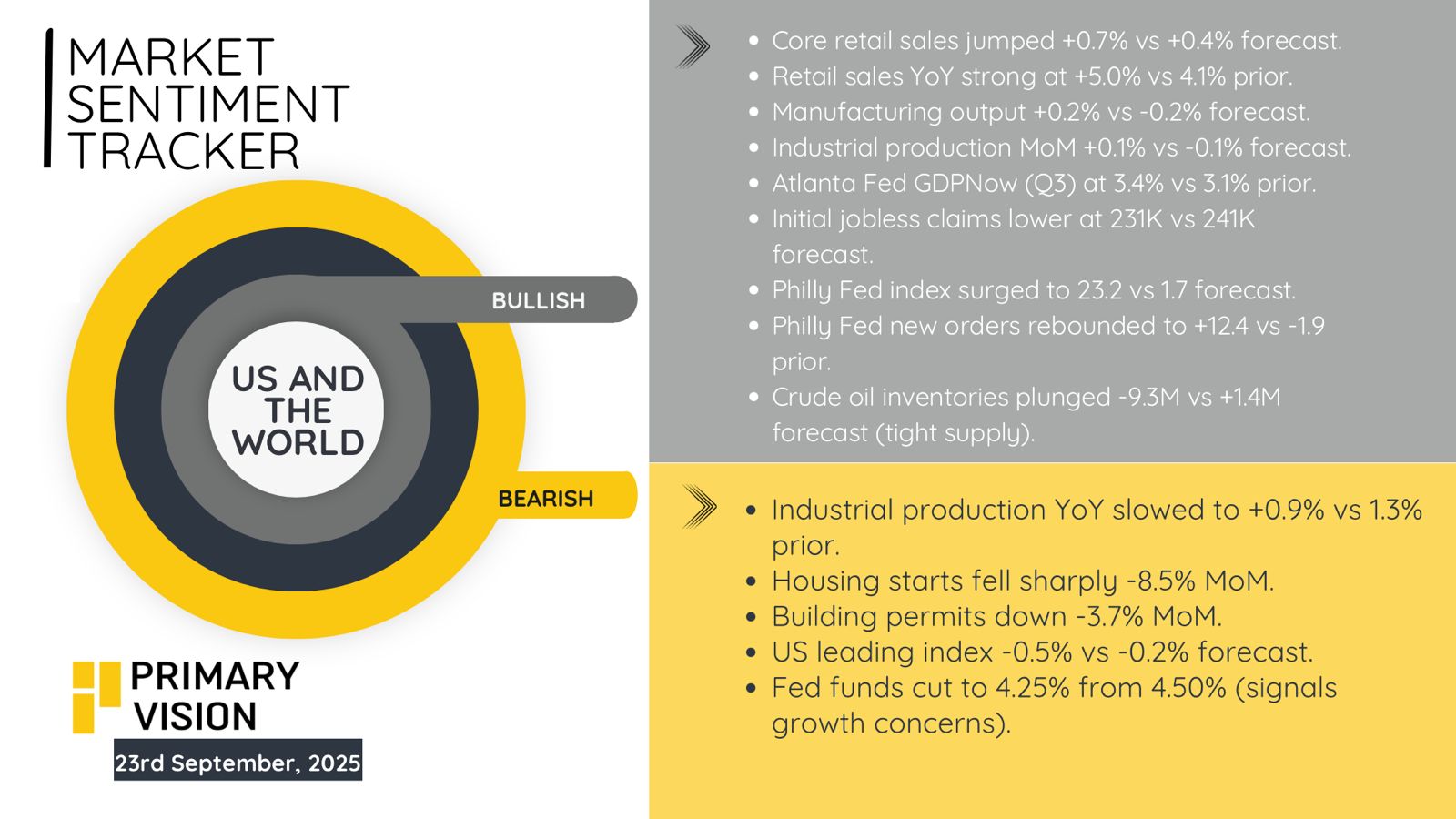
This week while combing through macroeconomic indicators of EU, China and U.S., global data pulse looked “green” at first glance, but then I realized signal underneath is a different color. In the U.S., consumers are still carrying the expansion: August core retail sales rose a punchy 0.7% (headline up 0.6%), with year-on-year growth at 5.0%—clean beats that say demand hasn’t cracked yet. Manufacturing also flickered back to life (manufacturing output +0.2%; industrial production +0.1% m/m). Regional business sentiment ripped higher (Philly Fed to 23.2; new orders back in the black). Jobless claims edged lower. If you stopped there, you’d call it resilient. But housing is flashing red (starts -8.5%, permits -3.7%), the Conference Board leading index slipped again (-0.5%), and the Fed eased to 4.25%—a cut that reads less like victory and more like insurance against a growth downshift. Meanwhile, oil balances tightened dramatically (EIA crude -9.3M barrels), a reminder that supply-side frictions haven’t vanished. Put differently: America’s growth engine is still humming, but the drivetrain is rattling.
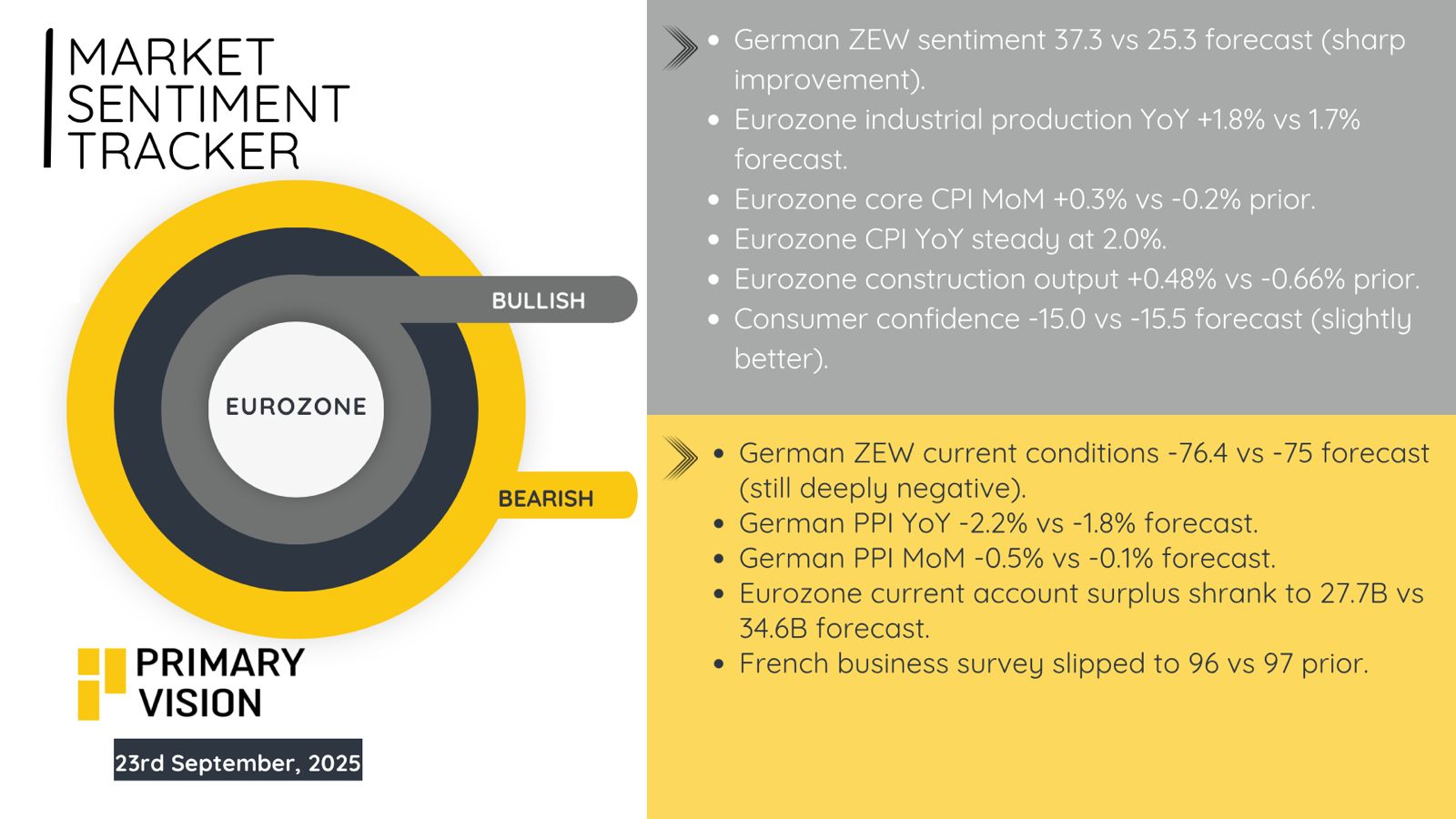
Europe delivered a similar two-tone picture. Forward expectations improved sharply (German ZEW sentiment 37.3 vs 25.3 expected) and hard activity was not as soft as feared (euro area industrial production +1.8% y/y). Inflation sat near target (headline 2.0% y/y; core up 0.3% m/m), and construction output ticked higher. Yet Germany’s producer prices fell faster (-2.2% y/y, -0.5% m/m), signaling persistent margin pressure at the industrial core, and the euro area current account narrowed versus expectations—a cooling external cushion. Consumer confidence remains negative, only slightly less so. Europe is not stalling, but it is growing into price disinflation that risks morphing into profit disinflation if demand doesn’t broaden.
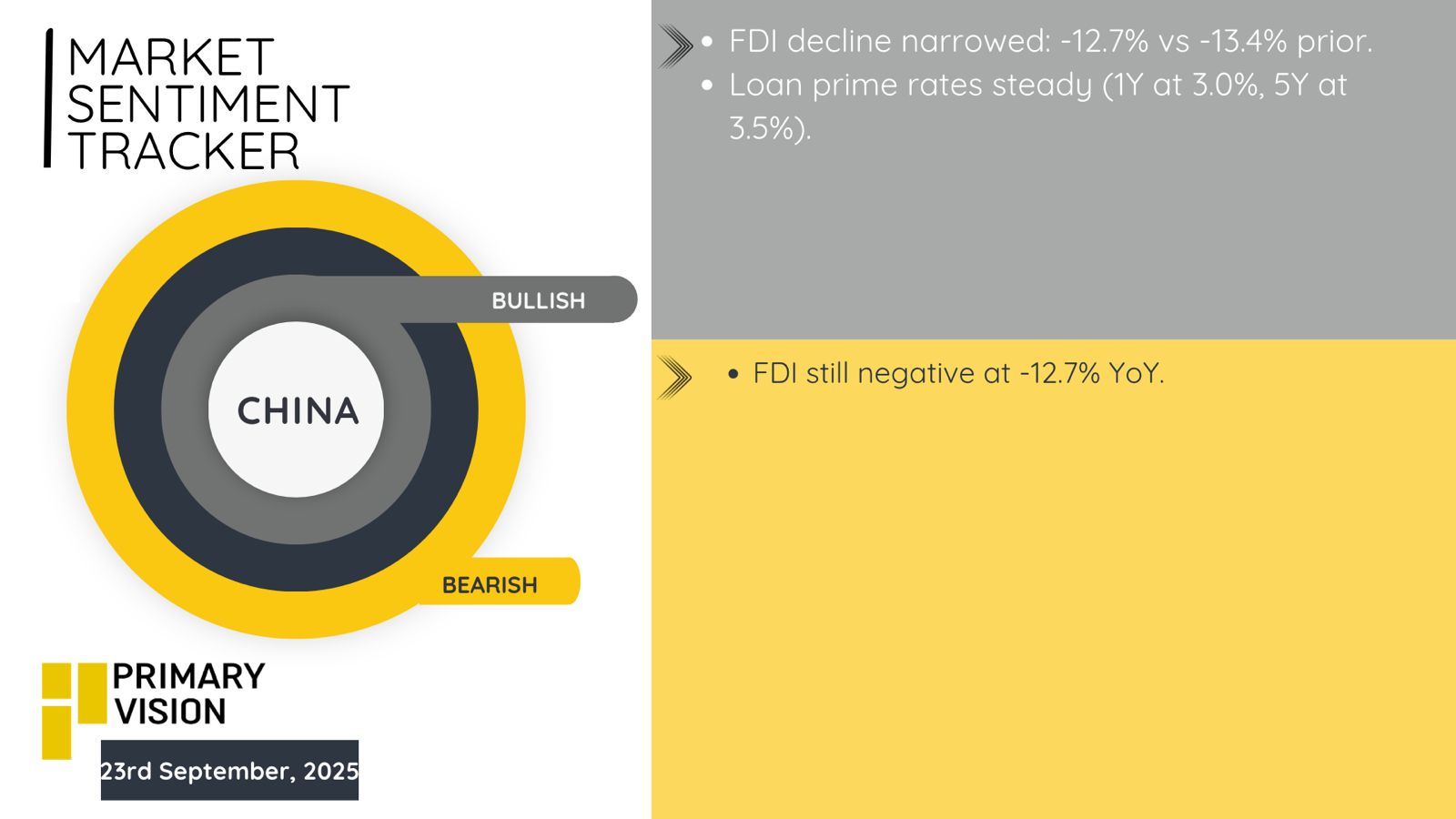
China was quiet but revealing. Loan prime rates were held steady (1Y 3.0%, 5Y 3.5%), and foreign direct investment remained negative (-12.7% y/y, marginally “less bad”). Stability is policy; momentum isn’t. With capital still hesitant and domestic confidence fragile, the economy is leaning on incrementalism rather than impulse. That stance steadies volatility but doesn’t kindle growth.
What’s the bigger picture?
Globally we are still in a late-cycle soft-landing attempt, but it’s an uneven landing: consumption-led strength versus interest-sensitive weakness; survey optimism versus price-pressure fragility; steady Chinese policy versus soft private capital flows. The encouraging part is that inflation is no longer the binding constraint in most advanced economies. The challenging part is that growth now depends on breadth—on housing and capex re-engaging before consumer gas runs low.
The global story right now is one of narrowing supports. Growth hasn’t collapsed, but the base it rests on is getting thinner. The labor markets that held everything together are softening, and once jobs roll over, the consumer strength we’ve relied on will fade more quickly than people expect. On the other side, inflation hasn’t fully let go. Headline has eased, but the core stickiness in services and the risk from energy or supply shocks mean it doesn’t give central banks a free hand.
That leaves policy in an awkward spot — cutting just enough to cushion growth, but not enough to reset the cycle. It’s neither stimulus nor restraint, and markets can sense that hesitation. The bigger point is that the cycle isn’t converging to a neat soft landing; it’s fraying. Jobs are weakening faster than inflation is easing, and that mismatch is what drives instability.
The outlook isn’t about neat binaries anymore — it’s not strong versus weak, or soft landing versus recession. What we’re dealing with is a cycle that can’t find its balance. Growth is losing momentum, inflation isn’t fully under control, and every shock that hits the system carries further because the buffers are thinner. The danger isn’t an outright collapse — it’s a stretch of grinding instability, where markets keep swinging between relief and anxiety until something breaks that pattern, whether it’s a decisive policy move, an energy shock, or a geopolitical jolt.
Permission denied
Upgrade to Pro Today and get…
• This article — plus dozens more each month, all within our full Research Module
• Frac Hits — our National-Level Frac Spread Count and Frac Job Count, updated weekly
• Frac Operator Monitor — detailed FSC & FJC by operator
• And so much more, designed to help you track, forecast, and outperform