







Articles
- BLOG / Articles / View
- Articles
Market Sentiment Tracker: Recession in pieces?
By Osama on November 4, 2025 in Market Sentiment
Latest data from U. S., Europe and China is out. Lots to unpack here. Let's start with the U.S.
Treasury Secretary Scott Bessent’s acknowledgment that “some sectors are already in recession” exposes a widening split beneath the U.S. headline numbers. The administration’s rhetoric of strength contrasts sharply with household data showing a real squeeze. Roughly 42 million Americans risk losing food benefits amid the federal shutdown, while 20 million ACA policyholders face average premium hikes of over $1,000 a year as subsidies expire. Lower-income families—who drive the bulk of discretionary spending—are entering the holiday season with less cash and rising anxiety. The Fed’s latest surveys describe the same pattern: a bifurcated or “K-shaped” economy, with affluent households, buoyed by equity gains and AI-related wealth effects, still spending on travel and luxury goods, while middle- and lower-income cohorts pull back.
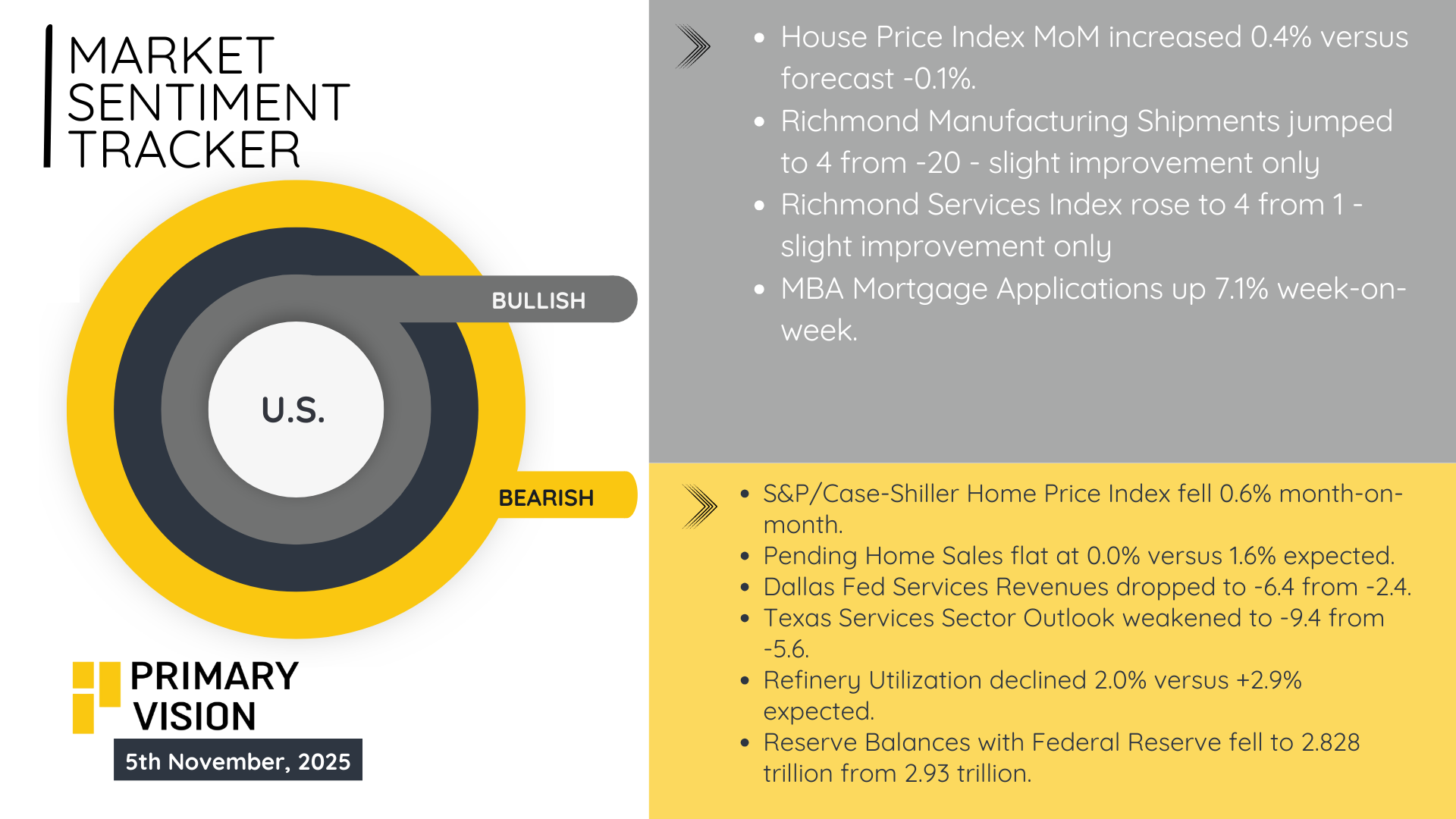
Chipotle’s data show frequency declines among guests earning under $100 k, roughly 40 percent of its sales, mirroring broader retail softness. Unemployment among 20- to 24-year-olds has climbed to 9.2 percent, up from 7.9 percent a year earlier, while major firms from Amazon to UPS have announced layoffs. Consumer confidence fell again in October, consistent with weak regional business surveys. Flat pending home sales, a 0.6 percent fall in the S&P/Case-Shiller index, and declining refinery utilization point to cooling activity.
The resilience Powell cites is increasingly narrow. High-income consumption and AI-linked investment may keep GDP positive, but the composition is unhealthy. Without fiscal stabilization for the lower half of households, further Fed easing, already underway, risks cushioning markets more than the real economy. We can expect Q4 growth near or just slightly above 1 percent and rising political pressure for policy measures targeted at the median consumer rather than the stock market.
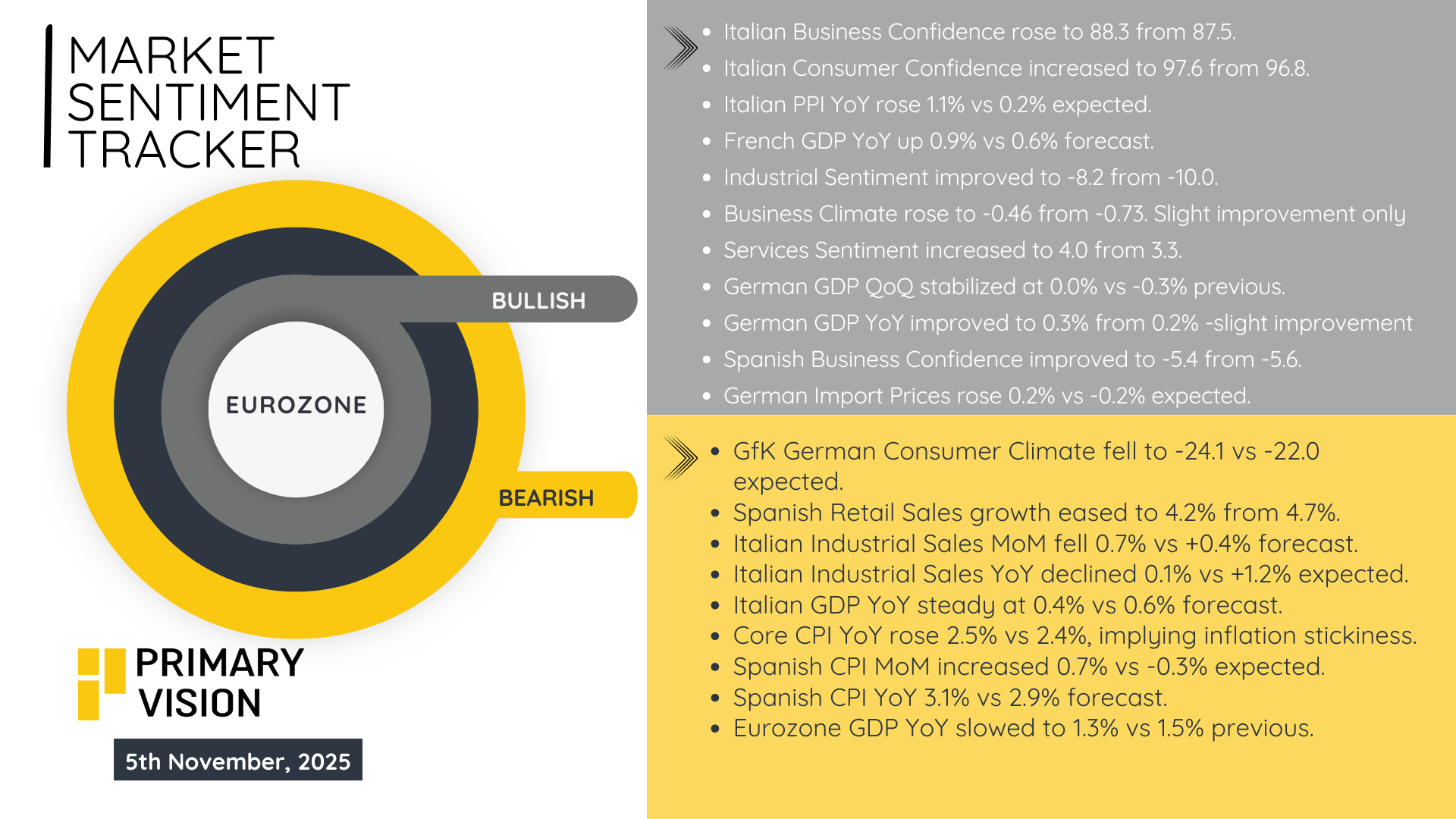
Europe’s third-quarter 0.2 percent growth conceals an economy trapped by fear and policy inertia. Germany’s output is flat, France carried the bloc with 0.5 percent QoQ growth, and the Eurozone’s 1.3 percent YoY expansion barely offsets last quarter’s 1.5 percent. Beneath that, households are hoarding cash—Europe’s saving rate near 15 percent versus 5 percent in the U.S. as geopolitical and economic uncertainty depress spending. Stagnant wages, high energy costs, and anxiety over U.S. tariffs and Chinese competition keep consumers and corporates cautious.
This fear feedback loop, weak demand curbing investment, and weak investment reinforcing low demand, now defines the region. Italian and German confidence indices ticked up slightly, but business activity remains subdued. Core CPI at 2.5 percent YoY signals inflation stickiness even as growth falters, complicating ECB policy. Fiscal nerves persist: Romania’s 9.3 percent-of-GDP deficit highlights a north-south divide on stimulus appetite.
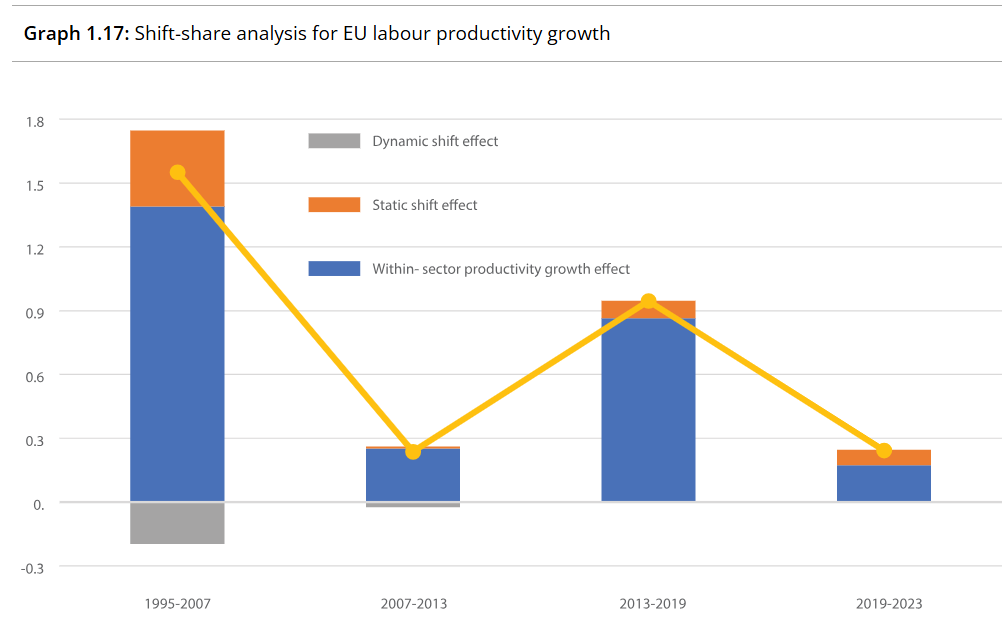
Mario Draghi’s competitiveness report warns of a looming labor shortfall where 2 million jobs can be lost annually by 2040 yet migration constraints and fragmented capital markets prevent a productive reallocation of savings. Policymakers talk of regulatory simplification but avoid the “big buttons”: a larger EU budget or real capital-markets union. The result is an economy stuck at stall speed, with high savings, limited investment, and policymakers too risk-averse to change course. We can expect slow disinflation, modest growth, and a slow-motion drift toward fiscal mutualization only after another shock forces it.
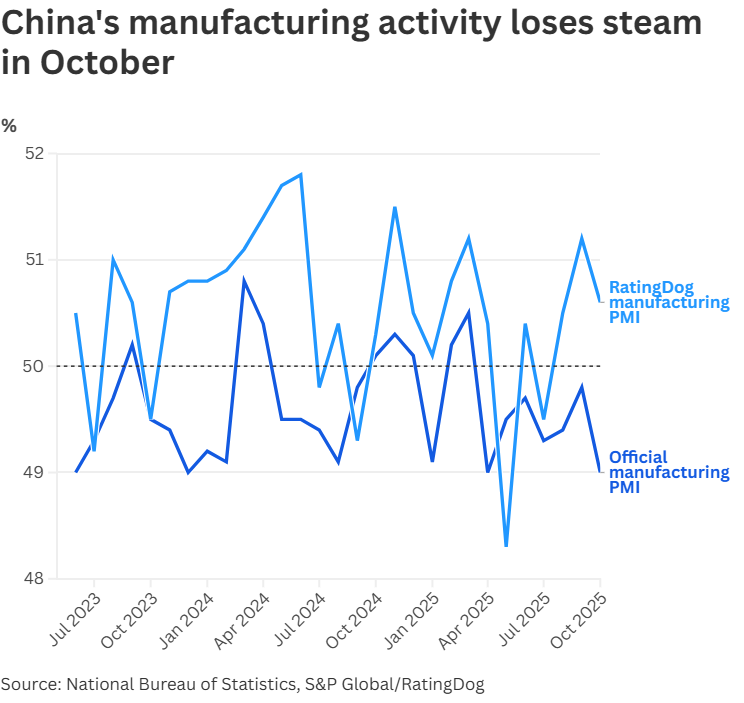
China’s October data confirmed slowing momentum. The private RatingDog manufacturing PMI eased to 50.6 from 51.2, missing forecasts, while the official gauge slid to 49.0, the sharpest contraction in six months. New export orders fell at their quickest pace since May amid renewed U.S. trade tensions, and business confidence hit a six-month low. Employment improved marginally, the first uptick since March, but overall sentiment weakened.
Growth is now running at 4.8 percent YoY in Q3, the slowest in a year, while fixed-asset investment—including real estate—contracted 0.5 percent in the first nine months, the first drop since 2020. Exports remain the bright spot, up 6.1 percent YTD, with shipments to ASEAN up 14.7 percent and to Africa 28 percent, offsetting double-digit declines to the U.S. Imports, however, fell 1.1 percent, reflecting domestic softness.
The U.S.–China trade truce offers tactical relief. Washington halved fentanyl-linked tariffs to 10 percent; Beijing paused rare-earth export curbs and dropped investigations into Nvidia and Qualcomm. That détente led Goldman Sachs to lift its 2025 GDP forecast to 5 percent, but the base effect from last year’s 5.4 percent Q4 surge limits near-term upside. The fading of stimulus—consumption vouchers, local bond issuance, targeted lending shows diminishing returns.
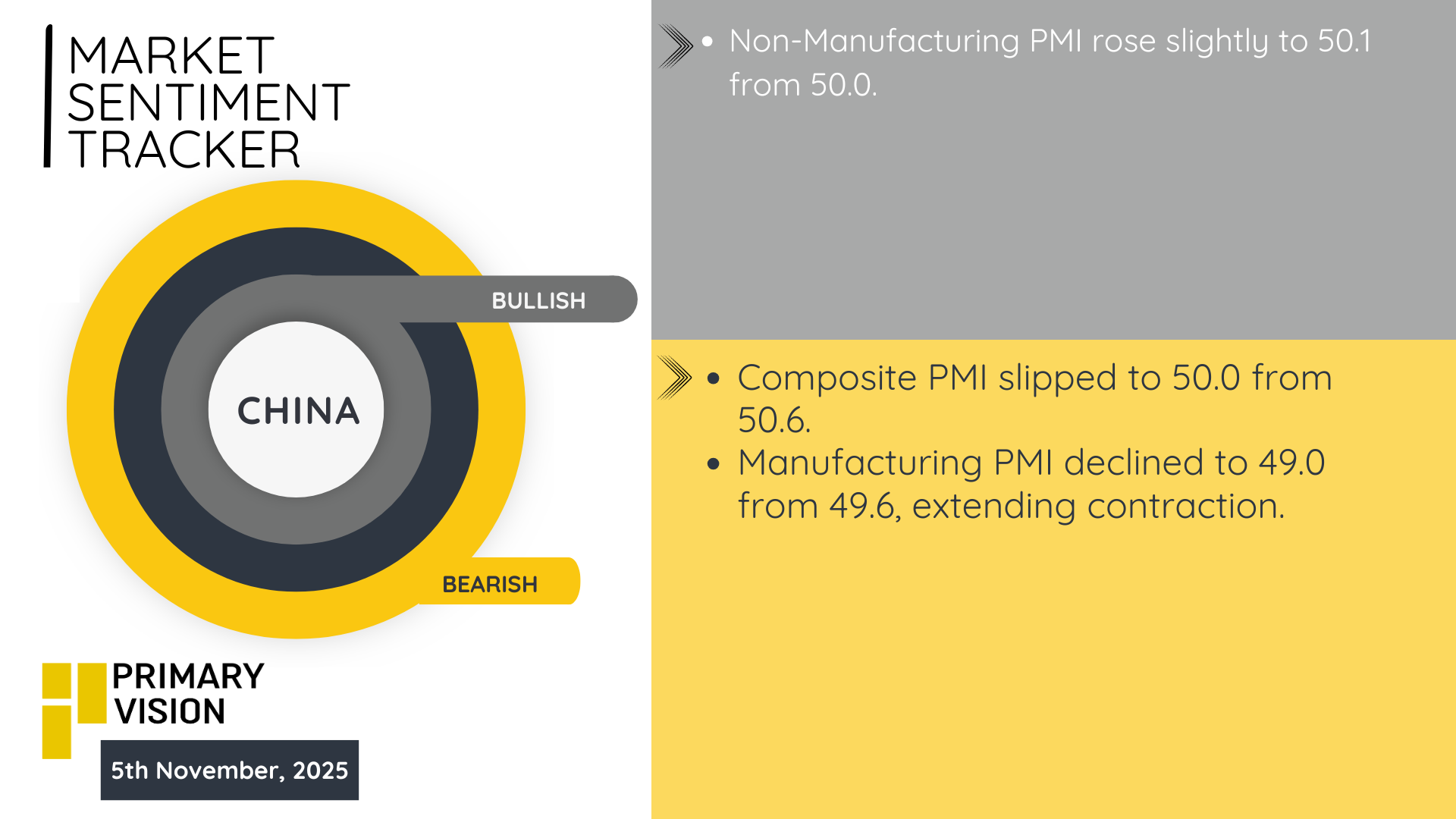
Beijing faces a structural bind: maintain credibility on debt discipline or risk stagnation by under-stimulating. Without a decisive shift toward household income growth and property stabilization, 2026 will look like 2025: a narrow manufacturing-led recovery capped by weak confidence.
Permission denied
Upgrade to Pro Today and get…
• This article — plus dozens more each month, all within our full Research Module
• Frac Hits — our National-Level Frac Spread Count and Frac Job Count, updated weekly
• Frac Operator Monitor — detailed FSC & FJC by operator
• And so much more, designed to help you track, forecast, and outperform