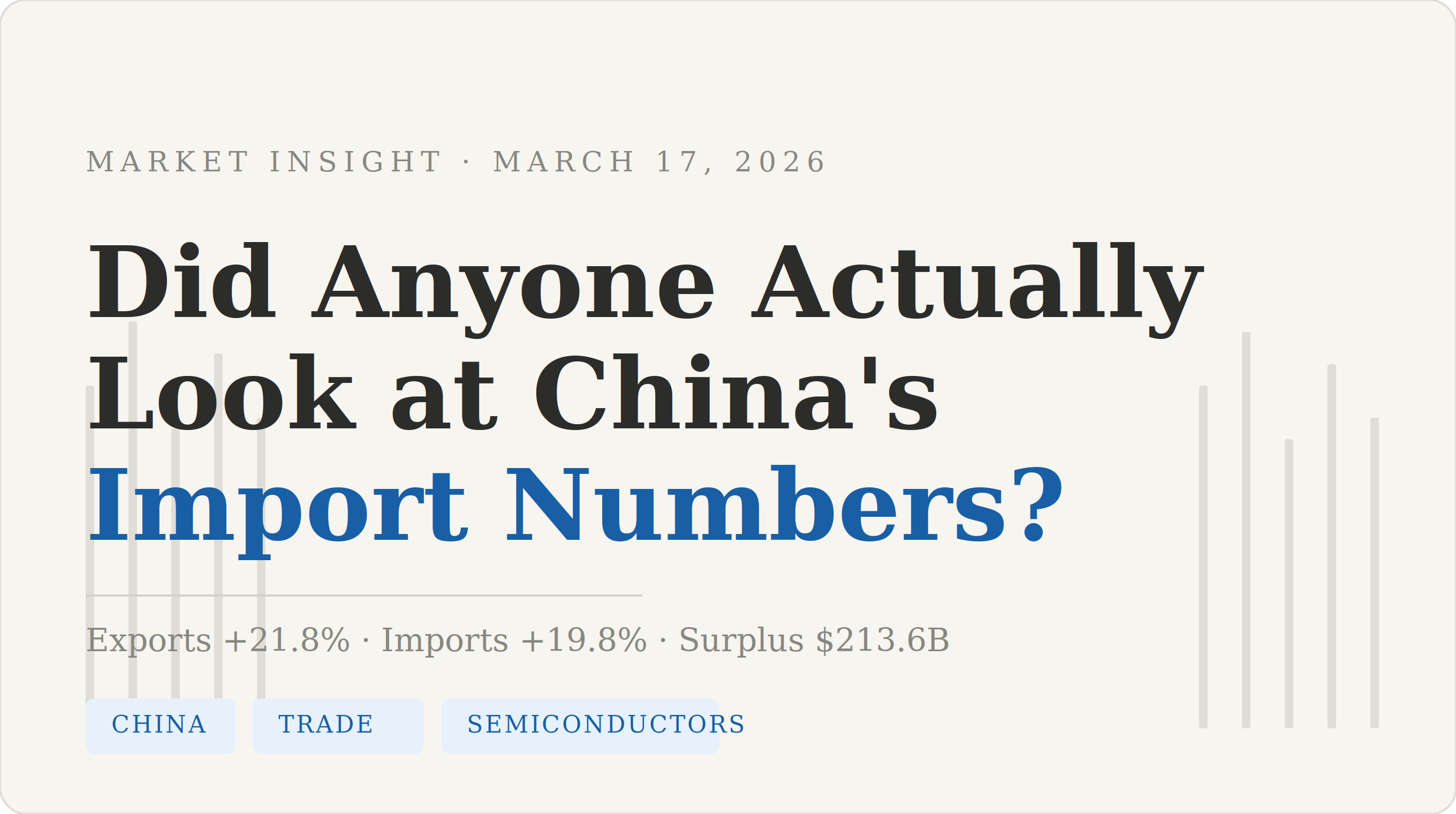
Market Sentiment Tracker: Did Anyone Actually Look at China's Import Numbers?
By
Osama
on March 19, 2026
in
Market Sentiment
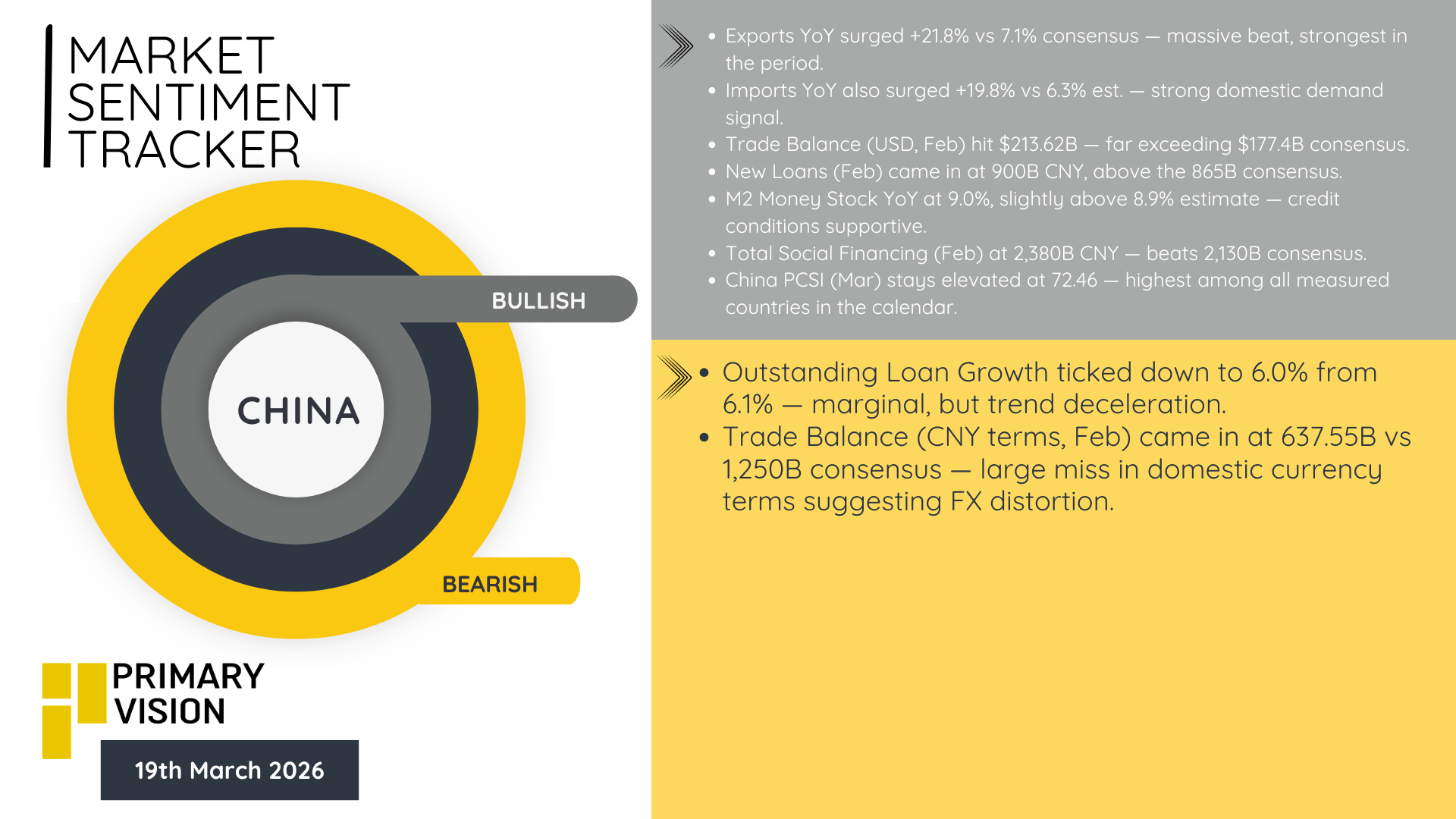
China's exports grew 21.8% in January–February. The forecast was 7.1%. Most coverage stopped there — record surplus, strong number, moving on. But the imports line came in at +19.8% against a 6.3% consensus, and that combination is what actually warrants a closer look.
+21.8%
Export growth YoY
+19.8%
Import growth YoY
$213.6B
Trade surplus (record)
+72.6%
Semiconductor exports YoY
The dominant explanation for the export surge has been front-loading — companies moving goods early before tariff conditions change, especially with the Trump–Xi summit scheduled for late March. That probably accounts for some of it. But exports to Africa were up 49.9%, ASEAN up 29.4%, Europe up 27.8% — all at once. Front-loading ahead of a US trade meeting doesn't explain growth across every major non-US destination simultaneously. Something broader is happening with where Chinese goods are going.
The imports beat is harder to explain away. The standard view on China's trade surplus is that it reflects weak domestic demand — the economy can't absorb what it produces, so it exports the excess. February's import number doesn't fit that story. Strong inflows from India, South Korea, Australia, and Latin America suggest China was also pulling in raw materials and components at pace. When both exports and imports beat by this margin at the same time, it usually means the economy is running hot through a cycle, not coasting on one engine.
Semiconductor export value rose 72.6% while volume grew only 13.7%. China shipped fewer chips and made significantly more money doing it — because the world is running short and willing to pay up.
The semiconductor detail is the most analytically interesting part of this dataset. Integrated circuit exports hit $43.3 billion in just two months, up 72.6% YoY. But volume only grew 13.7%. That gap between value and volume growth tells you this isn't simply more chips going out the door — it's the same chips going out at much higher prices. AI infrastructure spending is creating a genuine memory shortage globally, and China's mature-node capacity is filling a gap that few other producers can right now.
Worth noting: US-bound shipments actually fell 11%. The bilateral relationship is still under pressure, summit or not. But the overall surplus hit a record precisely because every other major destination absorbed more. The trade war changed where things go, not how much moves. For anyone thinking about inflation dynamics or supply chain relief in H2 2026, that geographic shift is the more important variable.
The one real risk to this picture is energy costs from the Iran conflict, which ING flagged as a potential stagflation trigger if it drags on. That's worth monitoring. But the February data, taken on its own terms, points to a Chinese export base that has genuinely diversified its destinations and is now benefiting from a global chip shortage it didn't engineer but is well-positioned to supply.
Upgrade to Pro Today and get…
• This article — plus dozens more each month, all within our full Research Module
• Frac Hits — our National-Level Frac Spread Count and Frac Job Count, updated weekly
• Frac Operator Monitor — detailed FSC & FJC by operator
• And so much more, designed to help you track, forecast, and outperform