In this part, we will discuss the impact of the recent decline in reserves. The U.S. Strategic Petroleum Reserve has fallen below 300 million barrels, but the significance of that level is clearer when measured against its recent history.
At 289.7 MMbbl on August 21, 2026, inventory was 54% below its 2019–2021 average and 41% below its 2019–2025 average. It was also below every weekly inventory observation in the 2019–2025 period. The current level therefore represents a materially smaller buffer than the one the SPR maintained before the 2022 emergency drawdown.
The 2022 Break Changed the Baseline
The sharpest change came in 2022. Following Russia's invasion of Ukraine, the U.S. authorized an emergency release of approximately 180 MMbbl from the SPR. Inventory fell from roughly 580 MMbbl at the beginning of the year to about 372 MMbbl by year-end.
That was not a normal inventory fluctuation. It removed roughly one-third of the reserve's starting inventory in a single year and established a much lower starting point for subsequent replenishment.
The SPR did begin rebuilding. Inventory reached approximately 413 MMbbl by the end of 2025, but that recovery restored only part of the previous buffer. The 2026 emergency release then pushed inventory below 300 MMbbl again. The current position is therefore the result of another major drawdown occurring before the reserve had recovered to its pre-2022 level.
The Latest Decline Is Large Relative to the Recent Range
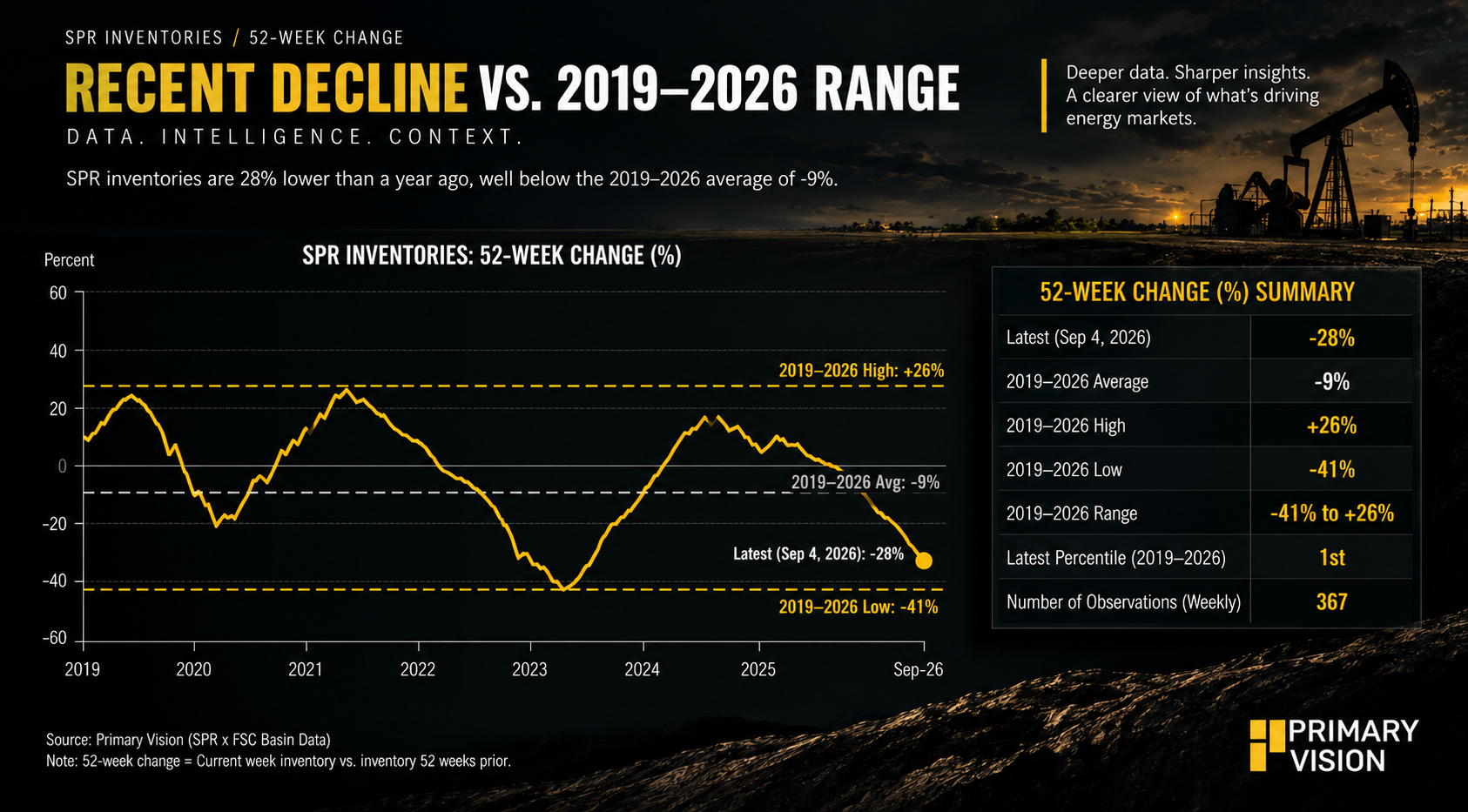
The latest decline is also significant when measured against the reserve's own 2019–2026 history. SPR inventory has fallen approximately 28.3% over the latest 52-week period. That is not unprecedented — the 2022 episode was larger — but it is roughly three times the 2019–2026 average 52-week change of -9%. The current decline therefore sits well below the historical norm, even if it is not the largest annual contraction in the available history.
Barrel Count Hides an Operating Constraint
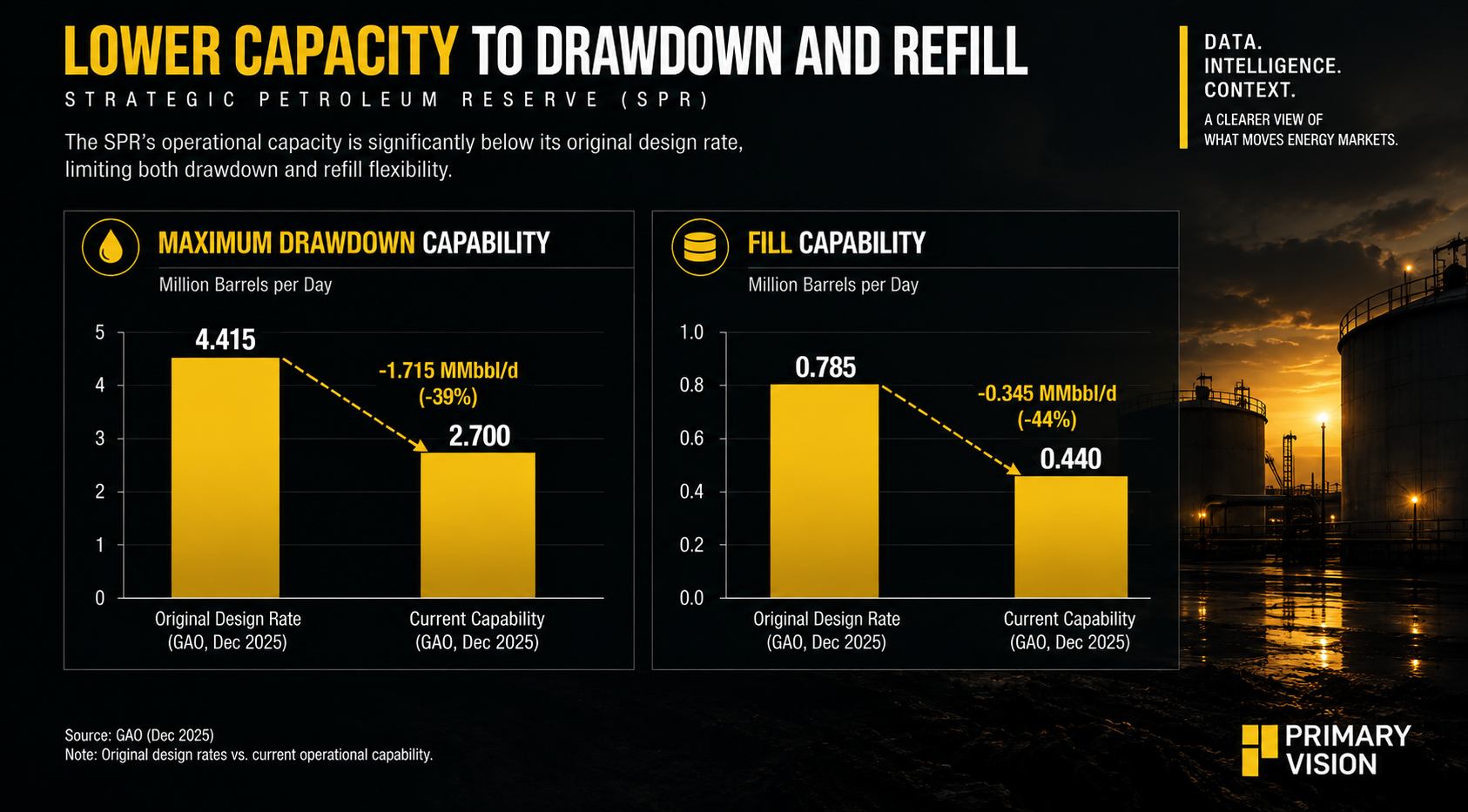
Inventory is only one part of the buffer. GAO (U.S. Government Accountability Office) reported that more than 25% of SPR inventory was unavailable for drawdown as of December 2025. Effective drawdown capability was approximately 61% of the original design rate, while fill capability was only 56%.
In other words, the SPR had lost approximately 39% of its original drawdown capability and 44% of its original fill capability.
The drivers are not simply low inventory. GAO points to aging infrastructure, construction and cavern outages, and the condition of the reserve's operating system. Deferred maintenance and required infrastructure work further limit the ability to restore the reserve's operating capability.
The Buffer Is Now the Question
The administration's 2026 emergency release of 172 MMbbl demonstrated that the SPR remains an active market-response tool. The subsequent plan to repurchase approximately 200 MMbbl creates the next test: rebuilding a reserve that is already well below its pre-2022 buffer while its fill capability remains below original design.
That is why 289.7 MMbbl matters. It is not simply that the number has fallen below 300 million barrels. It is 54% below the 2019–2021 average, below every weekly observation from 2019–2025, and sitting inside an infrastructure system operating materially below its original design capability.
The important question is therefore no longer just how much oil is in the SPR, but what the smaller buffer and reduced operating flexibility mean for those barrels when they have to be replaced. That is the question we take into the data next.
Upgrade to Pro Today and get…
• This article — plus dozens more each month, all within our full Research Module
• Frac Hits — our National-Level Frac Spread Count and Frac Job Count, updated weekly
• Frac Operator Monitor — detailed FSC & FJC by operator
• And so much more, designed to help you track, forecast, and outperform